
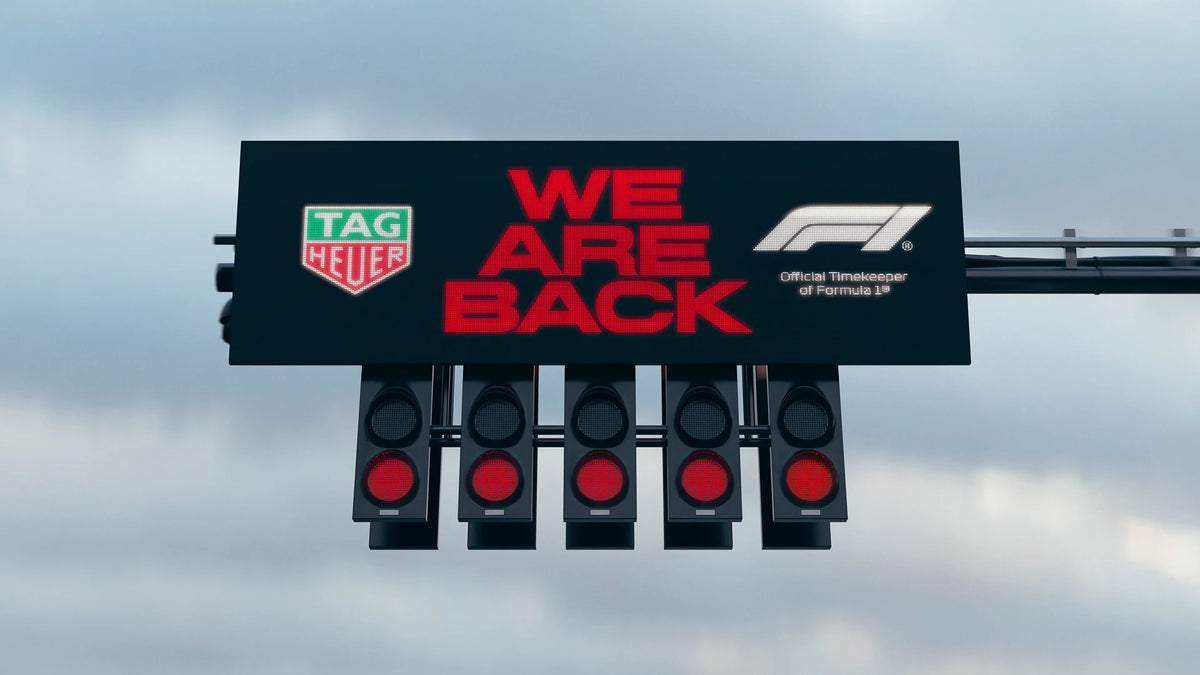
A watch logo beside a lap time looks like a simple claim: this brand measures Formula 1. The history is more interesting. A timing instrument, a championship's commercial designation, a team's sponsor and a driver's personal contract can all put watches into the same photograph while representing different agreements.
Formula 1 / TAG Heuer
Read the relationship before reading the logo
There are at least five layers: championship-wide partnership; race title sponsorship; team partnership; individual driver ambassadorship; and a licence to make branded products. A sixth category—an independently purchased watch—may involve no commercial relationship at all. This distinction is the foundation of a useful F1 watch history.
From the paddock to the car
Heuer's own archive identifies Jo Siffert's 1969 sponsorship as the moment its logo reached an F1 car. Formula 1 dates the Ferrari team agreement to 1971. The early relationship was tied to timing expertise as well as promotion: a practical need at the circuit helped give the watchmaker credibility.
These dates also explain a naming trap. In the early 1970s the company was Heuer; applying the later TAG Heuer name to an original dial or contract loses part of the story. We treat Heuer and TAG Heuer as one brand lineage in the directory, while preserving the period name in historical accounts.
The championship-level milestones
| Period | Watch company | Documented role and qualification |
|---|---|---|
| 1982–1991 | Longines | FHH dates its official F1 timing tenure from 1982 for ten years. This is the championship-level role, distinct from its Ferrari relationship. |
| 1992–2003 | TAG Heuer | Official Timekeeper; the dates are stated by both the brand and Formula 1. |
| From 2006 | Jacques Lemans | Official partner and licensee for F1-branded watches. A product licence is not proof of responsibility for race timing; the precise termination date is not established here. |
| 2010–2012 | Hublot | Official Watchmaker / Official Watch relationship. Contemporary reports also use “timekeeper”; the commercial title alone does not establish who operated the timing equipment. |
| 2013–2024 | Rolex | Championship-wide partnership, associated with Official Timekeeper and Official Timepiece designations, pit-lane clocks and trackside visibility. |
| From 2025 | TAG Heuer | Returns as Official Timekeeper as the ten-year F1–LVMH partnership begins. |
This is a timeline of watch-industry milestones, not an uninterrupted list of all technical suppliers. Electronics companies also appear in the record. LG's own November 2008 announcement specified an Official Data Processor role beginning in January 2009, including live timing and television graphics. It would be misleading to fill every intervening year with a watch brand just to make a continuous chart.
Why Hublot and Jacques Lemans belong in different columns
Jacques Lemans documents its 2006 F1 licence in its corporate presentation. Hublot's 2010 launch connected the championship to a dedicated King Power watch and paddock activity. Both belong in watchmaking's F1 history, but a consumer product, a sponsorship right and the operation of a timing system are different forms of participation.
Similarly, a modern mechanical chronograph is not the instrument that independently certifies an F1 result. Its value lies elsewhere: engineering, design, use as an ambassador object, or an association with the people competing. The existence of a commercial timing title should not be turned into an unsupported technical claim about a watch.
From Ferrari to McLaren to Red Bull
Formula 1 records the McLaren relationship from 1985 to 2015. TAG Heuer subsequently built its Red Bull partnership from 2016. The name also appeared on Red Bull's Renault-supplied engines: this was a branding arrangement, not a claim that the watch company manufactured the engine. Team agreements can overlap with championship-wide rights; the return in 2025 did not erase those other relationships.
The Gulf connection
The Hublot announcement took place at the Bahrain Grand Prix in March 2010. For readers following Bahrain, Jeddah, Lusail or Abu Dhabi, the paddock therefore offers more than a parade of expensive wristwear. Look for which rights a brand holds: the championship's logo, the team's identity, a driver's image or the name of the event. Those rights explain why several competing watchmakers can be visible during the same weekend.
What this history tells a collector
Our interpretation is that the strongest collaborations translate the sporting relationship into a meaningful object: a timing function, a material experiment, a design developed with a driver or a documented commemorative edition. A logo alone can prove an authorised association; it cannot prove technical transfer, rarity or future value.
Continue with our brand-and-team directory and the register of world champions. Each separates confirmed relationships from archival leads that still need evidence.


