
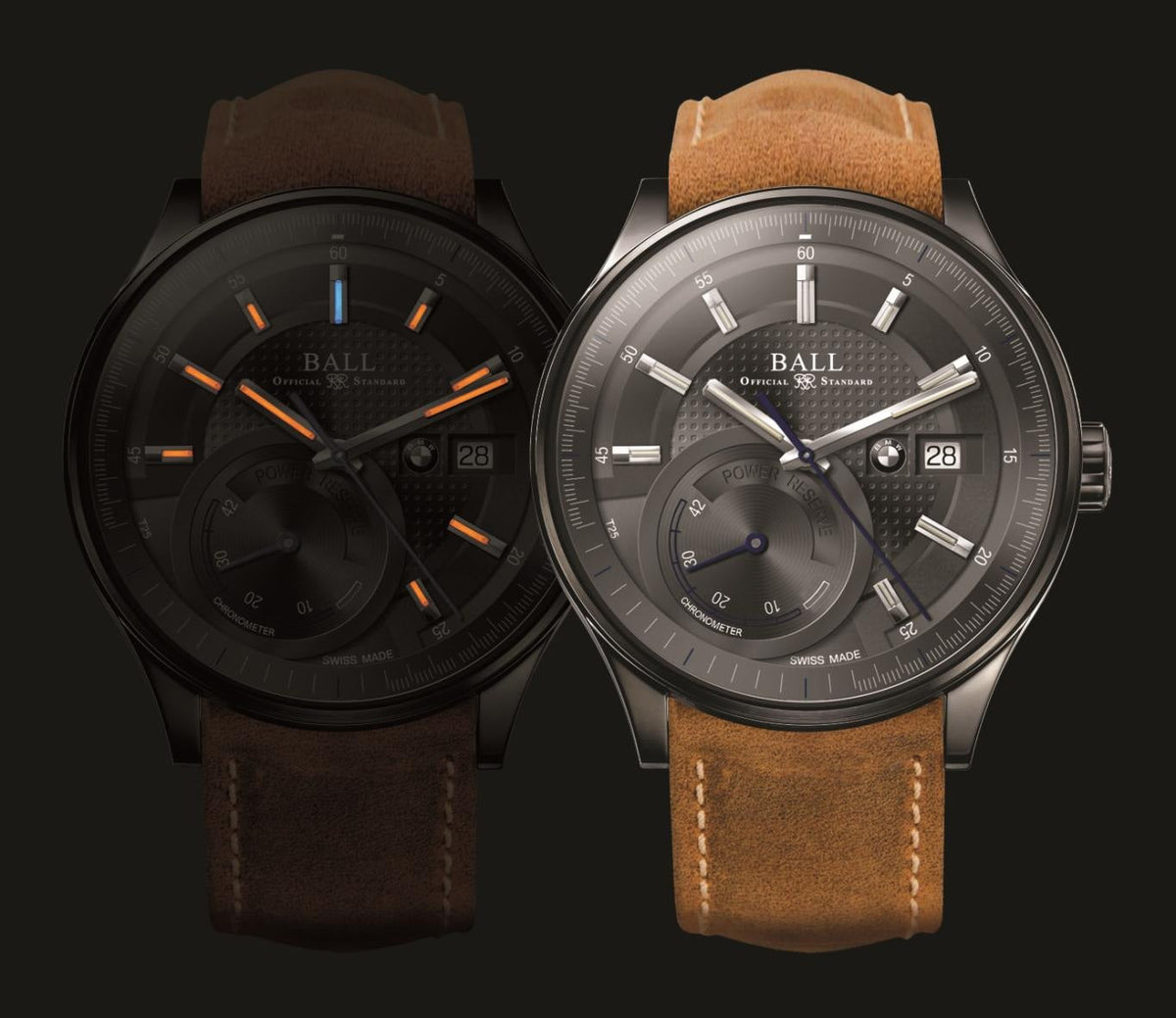
A car logo is easy to put on a watch. Giving the partnership a reason to exist is harder. The BALL for BMW collection, announced in 2012, attempted that harder task by making technical resilience part of its identity. It deserves to be read as a historical collaboration, rather than mistaken for a newly launched BMW watch range.
BALL Watch Company, 2016 collection imagery
The attraction of this case is its relative restraint. It does not rely on a clock worth a fortune occupying a coachbuilt dashboard. It concerns wristwatches intended to give an automotive name a credible place in ordinary ownership. That is a more revealing test of a licensing partnership than spectacle alone.
BALL for BMW: the mechanical proposition
Contemporary launch material put BALL’s Amortiser shock-protection concept at the centre of the collection. A protective ring around the movement addressed the problem of shocks reaching delicate watch components. The connection with the language of automotive suspension was clear, but the mechanisms should not be confused: a watch is not fitted with a miniature BMW chassis.
The launch references also resist generalisation. The Classic NM3010D used a 40 mm case and an ETA 2892-2, while the 42 mm GMT GM3010C used the ETA 2893-2. Both were presented as COSC-certified chronometers. A collection can share an identity without sharing every dimension or function.

BALL Watch Company, 2016 collection imagery
BMW’s own 2013 gift announcement provides a concrete example. It described a 42 mm steel BALL for BMW GMT with a Swiss automatic movement, a second time zone, sapphire crystal and a screw-in crown. Those are watchmaking features that can be assessed independently of the emblem. They also distinguish the piece from other BMW-branded watches with different movements and price positions.
Why the distinction matters
The words ‘BMW watch’ can conceal several very different products. A quartz accessory, an automatic GMT and a mechanical dashboard clock are not interchangeable categories. Nor does a carmaker’s name on a dial establish that its engineers developed the movement. The actual reference, calibre and manufacturer carry more useful information than the logo alone.
The same discipline applies to technical vocabulary. A chronograph measures elapsed time; a chronometer concerns a standard of rate performance. Shock protection addresses another problem again. Combining these words into a general impression of ‘precision’ makes poor criticism and an even poorer buying guide.
Brand affinity has a price
An automotive partnership competes for a second budget after the car has already been purchased. It offers the owner a way to carry a brand affiliation into places where the vehicle is absent. That is commercially sensible. The risk is asking the watch enthusiast to pay for an allegiance that contributes little to the object.
A stronger collaboration makes the comparison less comfortable. If the case, legibility, protection and movement form a coherent product, the badge becomes one reason to choose it rather than the sole reason it exists. BALL for BMW is interesting because its technical pitch makes that comparison possible. It does not prove that every buyer will prefer the result.
How to read one today
An older example should be judged as an older mechanical watch. Reference accuracy, originality, service history and the condition of the crown, crystal and strap matter more than a nostalgic product photograph. Any specialised protective system also deserves an informed discussion with the service provider, rather than an assumption that a familiar car dealer can support it.
An archived launch is not evidence of current factory availability, current warranty coverage or an active partnership. Equally, a watch offered for resale is not proof that the manufacturer has revived the collection. Those distinctions protect a good historical story from becoming a misleading shopping claim.
The lasting lesson is useful well beyond BMW. A successful car watch needs two explanations: why the automotive association makes sense, and why the watch remains worth discussing when that association is temporarily set aside.


