
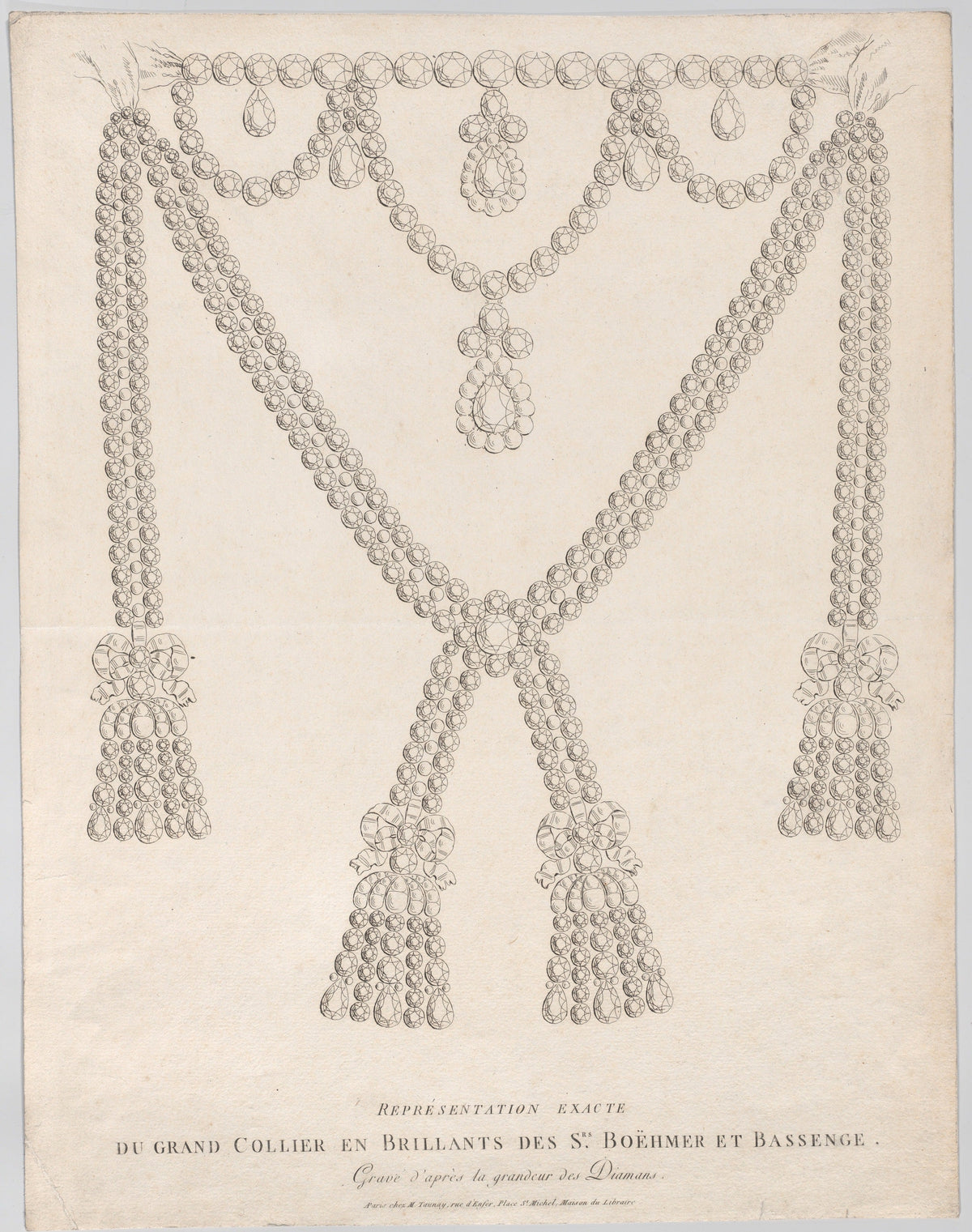
A necklace can damage a reputation without ever touching its supposed owner’s skin. Marie Antoinette had declined the extraordinary jewel made by Böhmer and Bassenge. Yet in 1785, a purchase supposedly made in her name became one of the most destructive scandals of her reign. The central fact is easily lost beneath the diamonds: the queen was not the customer in the transaction that engulfed her. Her identity was the instrument that made the fraud work.
The Metropolitan Museum of Art · CC0
The diamond necklace behind the affair
The project had been conceived for Madame du Barry in Louis XV’s reign; the king died before it was completed. The jewellers’ asking price stood at 1.6 million livres. Such an object concentrates commercial risk: stones, labour and immobilised capital must find a buyer willing to purchase the complete design. A magnificent piece can be difficult stock. The more singular the commission, the smaller the group able to absorb it—and the temptation to welcome an apparently credible route to a sale.

Manner of Louis-Michel van Loo · Public domain
Jeanne de La Motte offered that route through Cardinal de Rohan, who wanted to regain the queen’s favour. In August 1784, a woman impersonating Marie Antoinette reassured him during a night-time encounter in the gardens at Versailles. The performance transformed an improbable claim of access into something he believed he had experienced. The key asset was not a diamond or even a forged document. It was the conviction that the intermediary possessed the relationship everyone else lacked.

Collection image · Public domain
A sale built around somebody else’s name
On 1 February 1785 the jewellers handed the necklace to Rohan, who passed it to La Motte. Payment was supposed to follow in instalments. The arrangement illustrates a familiar vulnerability in exceptional transactions: each participant can mistake another person’s confidence for independent confirmation. Rohan believed in his access; the jewellers believed in the royal buyer behind him. Ambition, an urgent sale and the apparent authority of rank gave the deception enough room to operate.

Collection image · Public domain
When payment failed to arrive, the distance between the supposed buyer and the real transaction became impossible to ignore. Rohan was arrested in August 1785. In May 1786, the Parlement of Paris acquitted him; La Motte was convicted. These outcomes did not repair the queen’s reputation. A legal proceeding could determine responsibility in a case, but it could not require a suspicious public to abandon a story that already fitted its image of the court.

Collection image · Public domain
The jewel escaped; the accusation remained
The necklace was broken up, and diamonds were sold separately. Its destruction as a design helped detach the stones from a single recognisable object. Reputation moved in the opposite direction: disparate allegations accumulated around one recognisable figure. This is the scandal’s cruel asymmetry. The jewel could be dismantled into marketable components, while the queen could not detach herself from the public meaning assigned to it. Her innocence did not prevent the affair from doing political damage.

ToucanWings · CC BY-SA 3.0
The affair did not cause the French Revolution by itself. Treating a complicated political collapse as the consequence of a necklace mistakes a vivid episode for a sufficient explanation. Its importance is more precise: it intensified a crisis of credibility. Luxury served as a language through which people judged authority. An extravagance the queen had rejected could still be used against her because the allegation sounded consistent with what many were prepared to believe.

Jean-Pierre Houël · Public domain
The oldest problem in a very modern market
The lesson for the luxury trade is not that impressive jewels attract dishonest people. It is that exceptional objects can encourage exceptional shortcuts. A person’s title, proximity or persuasive manner cannot replace confirmed authority to purchase or receive goods. The necklace affair endures because it shows two failures of verification at once: a transaction that accepted an invented customer, and a public narrative that could flourish without the customer ever having bought the jewel.

Élisabeth Louise Vigée Le Brun · Public domain