
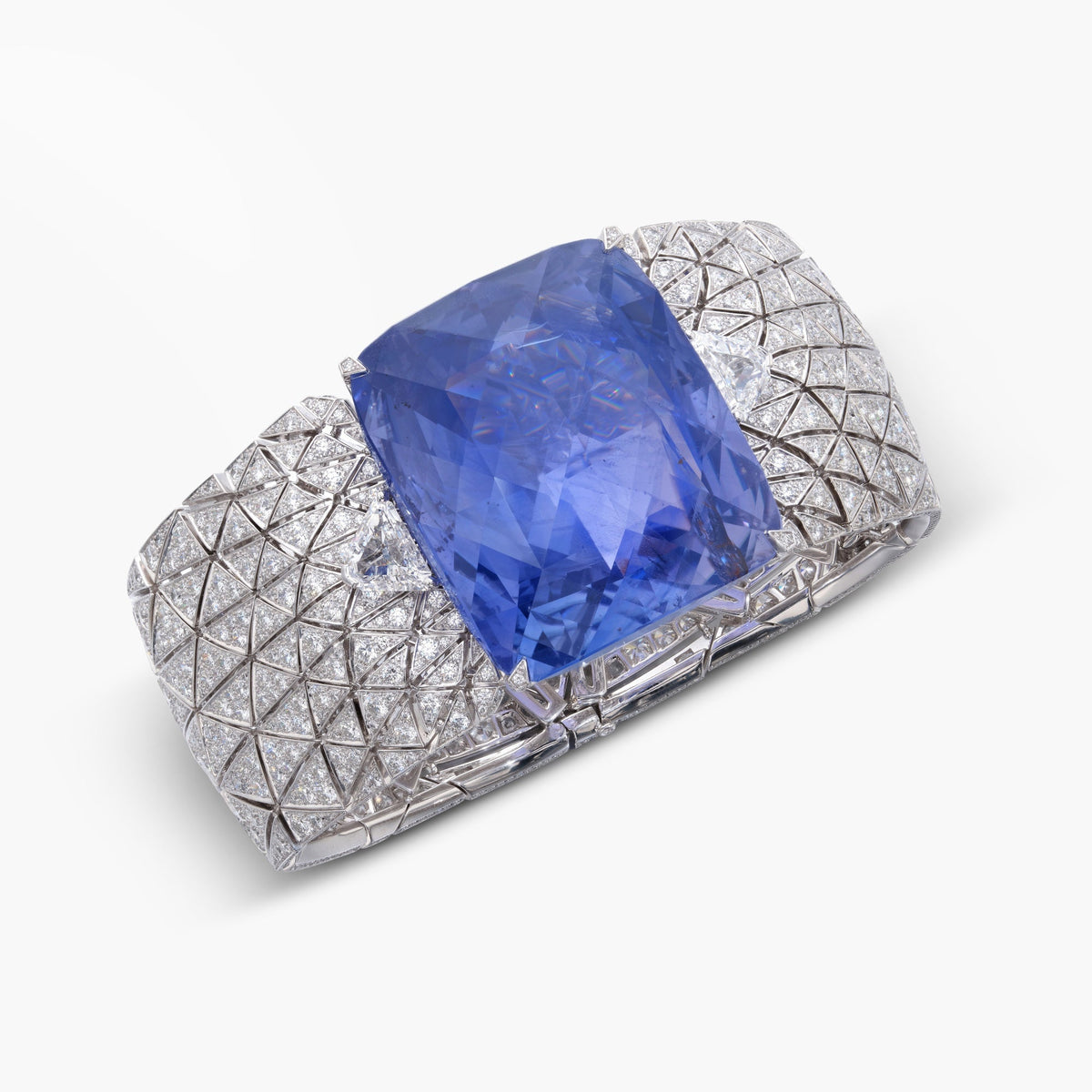
The stone’s imperial history is much older than its present setting. Its return to auction asks how material, documentation and modern design combine to give a jewel its identity.
One jewel with two different ages
A photograph can encourage an easy assumption: that the entire bracelet has survived intact from the Russian court. The distinction between stone and setting is the starting point here. The 197.80-carat Romanov Sapphire carries the imperial history; Cartier made its present bracelet around 2015. Offered as Lot 1080 in Sotheby’s Royal & Noble Jewels sale in Geneva on 11 November 2026, the piece has an estimate of CHF 850,000–1.7 million. That is a pre-sale expectation. The more interesting question is how a buyer will value the combination of a large gemstone, a documented past and a contemporary signed design.

Before the wrist came the imperial costume
The recorded history connects the sapphire with Dowager Empress Maria Feodorovna at the 1903 Winter Palace Ball, worn with a second sapphire in Fabergé settings on the front of her skirt. Jewels in that environment participated in a public language of ceremony and rank. The modern bracelet gives the stone a different kind of visibility, shaped by an individual wearer’s taste. This is more than a change of mounting. A gem can retain its material identity while moving between different systems of display. Its colour and scale survive, but the social meaning of showing them does not remain fixed.

The record that outlasted the treasury
After the Russian Revolution, the crown jewels were inventoried in the project known as the Fersman catalogue. Its present importance goes beyond gem descriptions: it supplies a reference point from before the dispersal of many objects. This sapphire subsequently entered the Soviet sales of imperial treasures. There is an economic tension in that journey. An object traded as valuable material can later attract attention as evidence of a lost historical setting. Recovering that identity requires records and convincing correspondences, however. Size and colour alone cannot make a blue stone an imperial relic. An old plate or inventory gives the claim something that can be examined.

Ganna Walska changes the stone’s role
Ganna Walska acquired the sapphire from Cartier in 1927. It appeared in different necklaces before later auction appearances in 1971 and 1992. The continuity belongs to the stone, rather than to one permanently preserved jewel. A new owner can keep the central gem while changing the way it is worn. Walska’s 1971 jewellery sale also had a purpose beyond collecting: she reinvested its proceeds in Lotusland, her garden. Portable wealth helped support a living project elsewhere. That transformation is a useful reminder that the meaning of possession can change within a collector’s own lifetime, as well as across political eras.

A modern setting makes its own contribution
Cartier’s geometric platinum-and-diamond bracelet includes an interchangeable engraved rock-crystal centre. Replacing the sapphire changes the jewel’s appearance and makes the modern design’s contribution especially clear. The present bracelet is neither an intact Romanov-era object nor a Fabergé creation. Those names belong to different stages of the sapphire’s history. Its value today has to be considered as a combination: the gem, the recent craftsmanship, the Cartier signature, wearability and the documentation accompanying the lot. Treating the setting as a disposable frame would overlook part of what is being offered; treating it as imperial would give it a past it does not possess.

What the laboratory language establishes
The listed SSEF and Gübelin reports describe a Ceylon origin—Sri Lanka—and no indications of heating. That distinction matters in sapphire collecting, but does not settle quality or price. Colour, its distribution, transparency, cut and condition still require consideration. Heat treatment is an established practice that should be disclosed; it does not make a sapphire an imitation. Precision also matters when discussing an unheated stone: the absence of evidence of heating should not be expanded into an unsupported claim about every conceivable intervention. Laboratory findings answer questions about the gem. Earlier ownership calls for a different body of evidence.

Geographical origin is not ownership history
The date when the sapphire entered the crown collection is not precisely recorded. Its cutting style has been associated with the Mughal period, a historical interpretation that is separate from its reported Sri Lankan geographical origin. Where a stone formed, how it was cut and who possessed it are distinct questions. Cartier materials and sale records help connect parts of its journey without making every intervening year equally certain. A persuasive provenance is not one with the most elaborate narrative. It is one whose established links, inferences and remaining gaps can be distinguished clearly.

The price of memory cannot be isolated
The estimate does not provide a simple calculation separating the sapphire’s material value from its history or the modern Cartier design. Bidders are considering a combined object. A large carat weight and an imperial association cannot guarantee a result, and one sale cannot establish the direction of the coloured-stone market. The catalogue also flags standard VAT on the hammer price and buyer’s premium, so the estimate alone is not the final acquisition cost. The enduring attraction is a different kind of continuity: a jewel can change its visible form while the stone retains a traceable connection to earlier lives. Documentation is what allows that connection to survive scrutiny.

Jewel and auction details
| Lot | 1080 |
|---|---|
| Gemstone | Cushion-shaped sapphire, stated weight 197.80 carats |
| Origin and heating | Ceylon, no indications of heating in the listed reports |
| Bracelet | Cartier, circa 2015, platinum and diamonds; alternative rock-crystal centre |
| Approximate inner circumference | 170 mm |
| Sale and date | Royal & Noble Jewels, Sotheby’s Geneva, 11 November 2026 |
| Pre-sale estimate | CHF 850,000–1,700,000 |
| Charges | Buyer’s premium additional; catalogue flags standard VAT on hammer price and premium |
Catalogue details checked on 3 November 2026 and subject to change. The estimate is not a sale result. This article is not based on physical inspection; condition and sale terms require review before bidding.


