
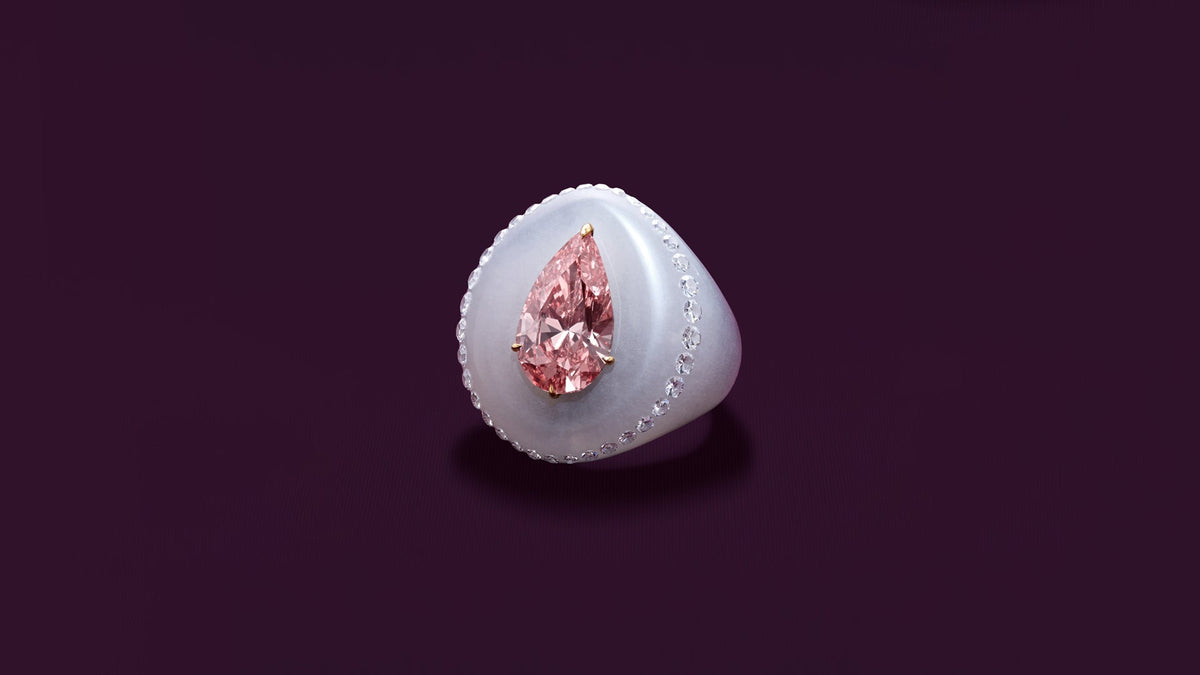
Cover: JAR chalcedony and pink diamond ring, an announced lot in the Pauline Karpidas jewellery auction. © Sotheby’s.
News Analysis | Jewellery & Auctions
Sotheby’s will offer 70 jewels from art collector Pauline Karpidas’s personal collection in a dedicated evening auction in New York on December 8, 2026. The group carries an aggregate estimate of around $10 million (approximately 37.5 million Saudi riyals). A public exhibition opens on December 2.
A JAR ring pairing a 10.10-carat orangy pink diamond with carved grey chalcedony leads the offering. Its importance extends beyond the centre stone: the collection brings an art collector’s eye to jewellery, embracing unusual materials and distinctive compositions alongside exceptional gems.
The collector behind the selection
Born Pauline Parry in Manchester in 1943, Karpidas moved to London and later Athens, where she opened a fashion boutique. Collecting developed alongside her husband, Constantinos “Dinos” Karpidas, with art dealer Alexander Iolas helping shape their direction. That background provides context for a jewellery collection spanning different makers and periods.
The auction follows sales of art and design from her London collection in 2025. Those earlier results cannot predetermine what the jewels will achieve. Individual design, condition and materials still matter, and the buyers assessing them may apply different criteria.

JAR’s pink diamond, considered as a complete jewel
The chalcedony and diamond ring is estimated at USD 2,500,000–3,500,000. Its pear-shaped centre stone is graded Fancy Intense Orangy Pink, with natural colour and VVS1 clarity according to the GIA report cited in the catalogue. Smaller diamonds border the carved grey body.
The relationship between that sculpted volume and the diamond’s colour directs attention to the whole composition. It also raises a commercial question: how much of the price will reflect the stone, and how much the authorship of Joel Arthur Rosenthal, known as JAR? The published estimate does not separate those contributions.

Basalt and diamonds: a different account of value
A second JAR ring, dated 1990 and estimated at USD 450,000–650,000, makes the role of design particularly apparent. Carved basalt supports an emerald-cut diamond, with small diamond-set spheres decorating the form.
The valuation cannot be explained by the rock alone. Authorship, execution and composition enter the discussion. JAR’s artistic standing also has institutional context: the Metropolitan Museum of Art presented “Jewels by JAR” in 2013–2014. That recognition provides context for the attention his work attracts; it does not guarantee a result for an individual piece.

Belperron and Cartier broaden the picture
Suzanne Belperron is represented by an aquamarine and diamond necklace-brooch combination estimated at USD 150,000–250,000. Its substantial stones and asymmetrical composition create a markedly different visual presence from conventional graduated rows.

Cartier’s Tutti Frutti clip-brooch, circa 1930 and signed Cartier London, combines carved emeralds and rubies with diamonds and pearls. It carries the same USD 150,000–250,000 estimate. The catalogue specifically notes that the pearls have not been tested for natural origin, so they should not be described as confirmed natural pearls.

A sapphire with two origin conclusions
A JAR sapphire ring in matte-textured platinum, estimated at USD 300,000–500,000, supplies an important reminder to read beyond the headline description. At the time of writing, its public catalogue entry lists an AGL report dated October 16, 2026, identifying Madagascan origin, and an SSEF report dated September 11, 2024, identifying Ceylon origin.
Both reports, as quoted by the catalogue, state that there are no indications of heating. Their geographic-origin conclusions differ. The public description does not explain why. The discrepancy warrants clarification from the auction house and examination of the reports; presenting one origin as settled would conceal information relevant to a buyer’s assessment.

What the auction can tell the market
The sale offers a useful test of how buyers weigh gem quality, distinctive design, a maker’s signature and collecting history. Association with a recognised collector may attract attention, but its independent contribution to price cannot be measured in advance or assumed to benefit every object equally.
All figures discussed here are pre-sale estimates, rather than realised proceeds or a buyer’s final cost. Estimates exclude buyer’s premium and applicable taxes and charges. SAR figures are indicative conversions at USD 1 = SAR 3.75.
December’s bidding will reveal what buyers are prepared to pay for these particular choices. Before then, the collection’s clearest contribution is visual: it demonstrates how an individual collecting perspective can bring rare stones, unconventional materials and strong design into the same conversation.


