
MALICHUS · EDITORIAL ANALYSIS · 30 October 2026 · اقرأ بالعربية
An alternative route into independent design
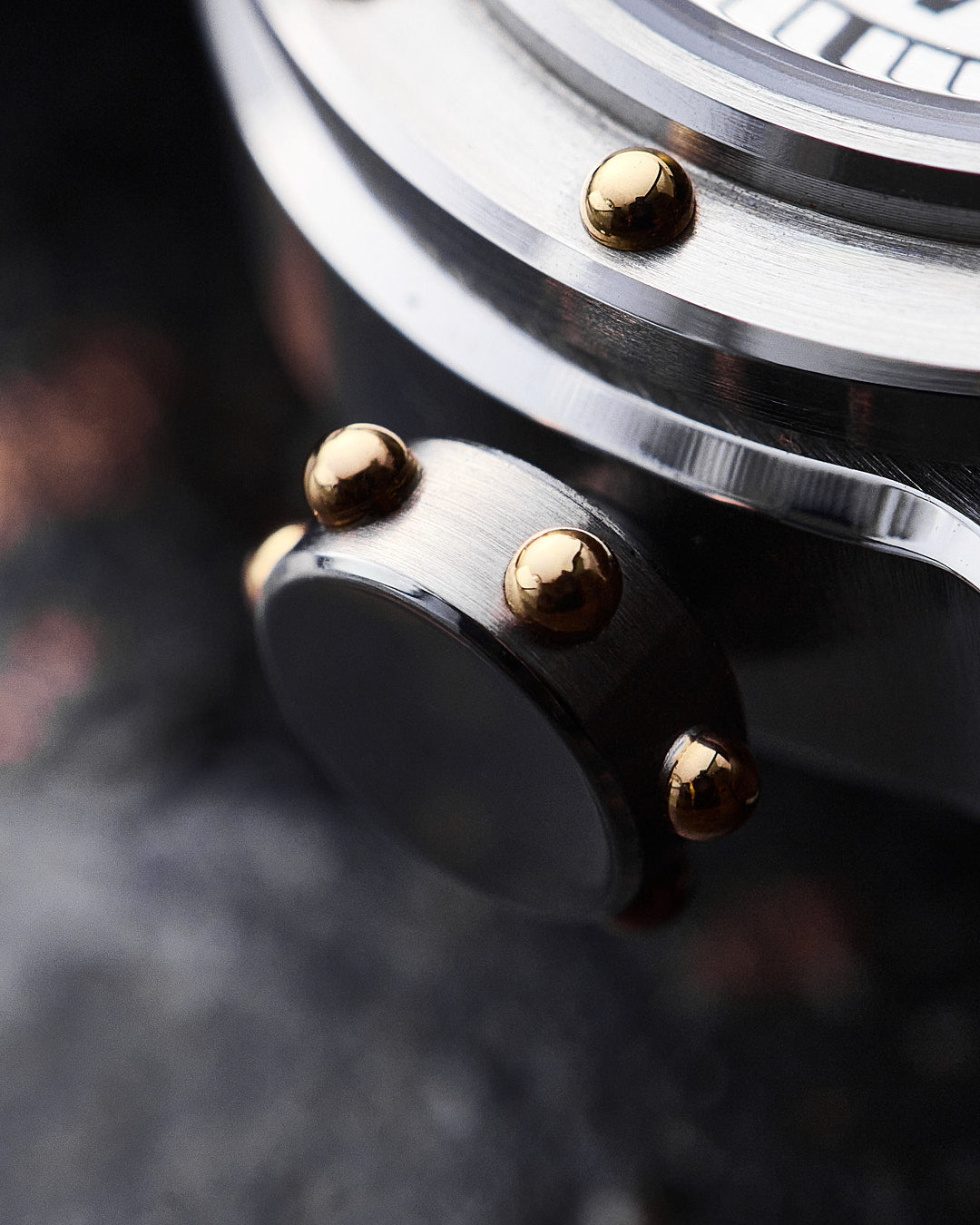
A collaboration can borrow a signature, or it can borrow a way of thinking. Futur Antérieur takes the latter route: the raised portholes, rivets and asymmetry associated with Halter become the organising principle of the watch. This is more consequential than applying a celebrated watchmaker’s name to an existing dial. The case itself has to accommodate the idea. For Louis Erard, the commercial proposition is clear: sell access to an identifiable creative universe without claiming to reproduce the entirety of the independent maker’s work.
Two engines, one indication of time
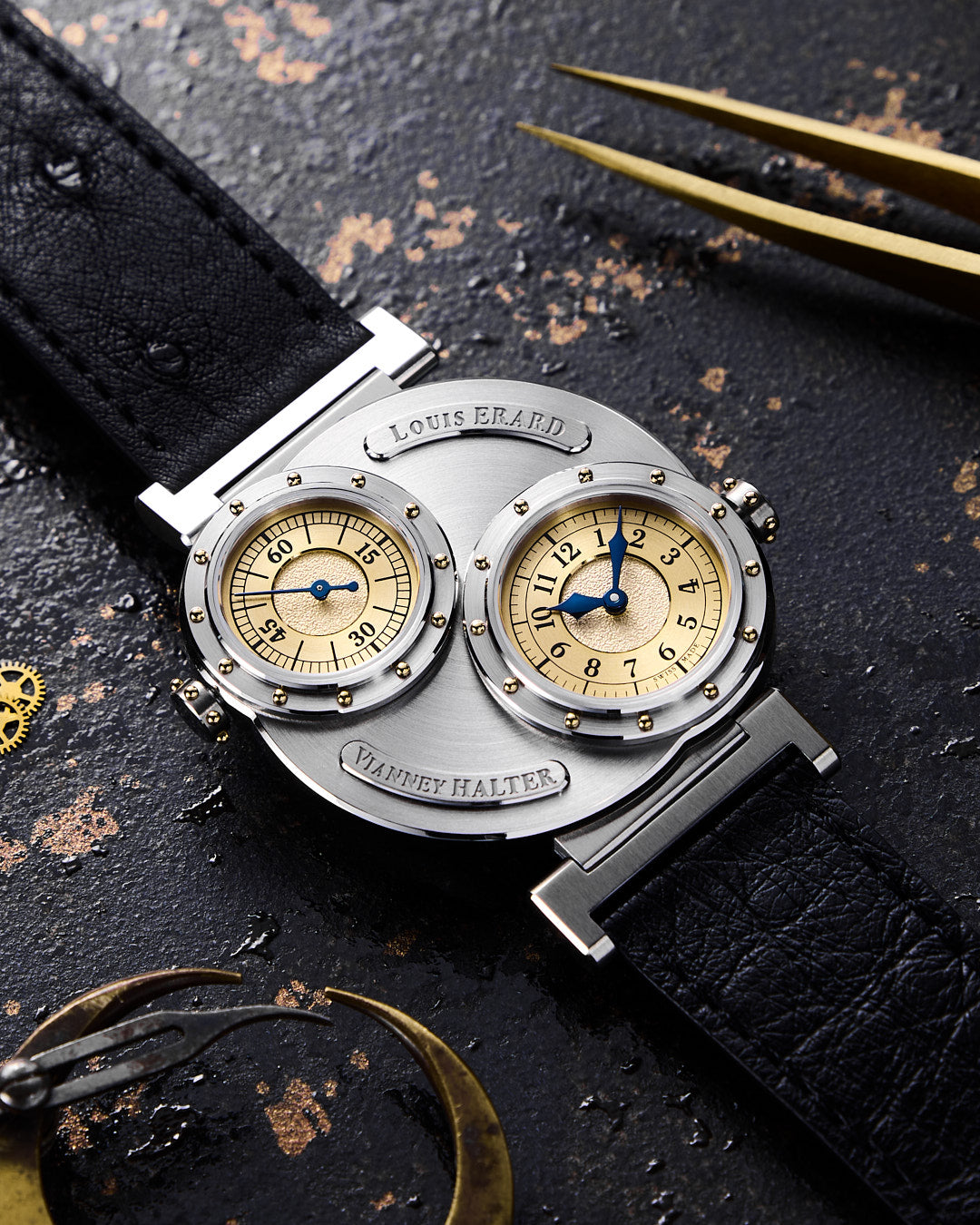
The larger dial shows hours and minutes; the smaller shows seconds. Each is driven by its own automatic Sellita SW100. The arrangement gives the designer considerable freedom because the seconds display does not have to occupy a position dictated by a single calibre’s wheel train. It also changes what the wearer is looking at. The seconds hand is not mechanically counting the same oscillator that governs the hour and minute hands. A small difference between the two displays is therefore an inherent possibility, rather than evidence that a single movement has stopped behaving coherently.
The price buys a composition
At CHF 4,950 before tax, the compelling question is not whether two industrial movements make a better timekeeper than one. It is whether the combined architecture, case work and authored design justify the purchase. The Gold name describes the colour treatment, not a solid-gold case. That distinction matters when comparing the watch with conventionally finished steel watches at a similar price. Its strongest argument is the coherence of the object; its limitation is that visual drama does not create additional timing functions.
Specifications, price and availability
| Case | Stainless steel; 38 × 44 × 8.85 mm |
|---|---|
| Movement | 2 × automatic Sellita SW100; 4 Hz; minimum 38 h each |
| Crystal; water resistance | Sapphire; 5 bar5 بار |
| Edition | 178 per colour / 178 قطعة لكل لون |
| Price | CHF 4,950 excl. tax |
Prices refer to the specified market and source when checked; they are not a Malichus sales offer or confirmation of local stock.