BUSINESS ANALYSIS | WATCH INDUSTRY
24 October 2026 · Malichus · اقرأ بالعربية
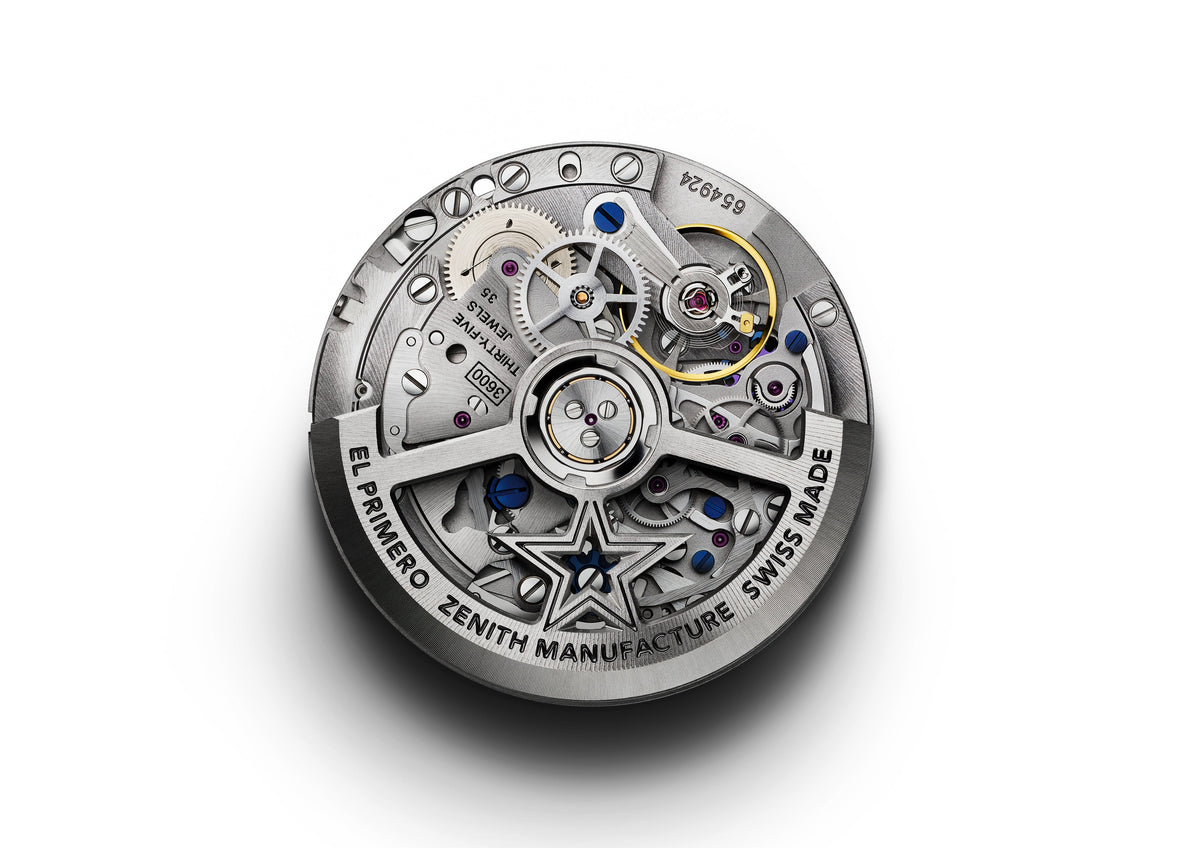
Cover: El Primero 3600, the modern movement used in the Chronomaster Sport. Photo: Zenith Japan / Wikimedia Commons · CC BY-SA 4.0.
The most revealing number in Zenith’s latest chapter is not a movement’s frequency or a chronometry prize. It is the number of jobs at risk.
On 22 October 2026, the LVMH-owned watchmaker began consulting employees on a strategic overhaul. Le Temps reported that roughly 100 positions at Le Locle could be affected, with another 100 abroad. These are proposed cuts, not completed dismissals.
For a company whose reputation rests on what happens inside a watch, the announcement raises a question that reaches well beyond Switzerland: why can extraordinary manufacturing competence coexist with a troubled business?
Zenith’s history offers an answer more complicated than poor products or insufficient heritage. Its recurring challenge has been to turn industrial authority into a clear reason for customers to choose Zenith itself. The distinction matters now that the company wants to sell fewer, more exclusive watches.
1865: the factory was the proposition
When Georges Favre-Jacot established his business in Le Locle in 1865, bringing watchmaking skills together within an integrated manufacturing operation was central to the project. Greater control over production could support consistency and coordination. Zenith’s identity began with the organisation of work, long before the contemporary luxury industry made “in-house” a selling point.
That origin helps explain both its durability and its present dilemma. A factory accumulates expertise, equipment and people. A luxury brand must also accumulate preference: the desire to own its particular watch when other excellent watches are available. These assets reinforce one another, but neither automatically produces the other.
The founder’s initials would eventually return on a very different proposition: the G.F.J., a collector-focused watch. The journey between those two moments is the story of a manufacturer repeatedly reconsidering how its expertise should be sold.

1949–1962: precision before El Primero
Zenith’s claim to serious watchmaking does not depend entirely on the El Primero. The Calibre 135, produced from 1949 to 1962, existed in commercial and observatory-competition forms. According to Zenith’s historical account, the competition 135-O won five consecutive first prizes in its wristwatch category at Neuchâtel from 1950 to 1954.
This distinction is important. Observatory movements were prepared for competitive timing trials; their results should not be presented as a guarantee for every production watch. What survives commercially is the credibility of a demonstrated discipline: designing and regulating mechanisms to keep time exceptionally well.
For today’s Zenith, that history provides a second foundation. A brand known chiefly for automatic chronographs can tell a broader story about precision, including restrained, manually wound watches. That is a more substantial basis for repositioning than adding precious metal to an existing design.
1969–1988: an invention survives its own obsolescence
Presented on 10 January 1969, the El Primero combined integrated automatic winding with a high-frequency chronograph running at 36,000 vibrations per hour. It belonged to the fiercely contested arrival of automatic chronographs; its particular technical combination is more useful to understand than an unqualified claim to being first.
A chronograph adds a stopwatch function to a watch. Zenith had created an important mechanism at almost exactly the moment electronics began challenging the economics of mechanical timekeeping. In 1975, production of the El Primero was halted. Watchmaker Charles Vermot preserved essential tooling and documentation, helping make its eventual return possible.
Demand from other manufacturers gave that preservation a commercial purpose. Phillips dates the sale of remaining El Primero movement blanks to Ebel to 1981, followed by Ebel’s chronograph launch in 1982. From 1988 to 2000, Rolex used its own modified version, Calibre 4030, in the automatic Daytona.
The relationship is evidence of Zenith’s competence. It is not evidence that Zenith and Rolex had interchangeable products, brands or businesses. A supplier can provide something indispensable while the customer-facing company captures a different form of value through design, distribution and demand for its name.
For Zenith, the Daytona connection is therefore both an endorsement and a strategic challenge. It gets people talking about the movement. The next task is getting them to want the watch carrying Zenith on the dial.

1999–2010: moving upmarket, then rebuilding the base
LVMH acquired Zenith in 1999. Its 2002 annual filing already described an upscale repositioning, precious-metal products, larger designs and a sharply higher average selling price. The group also planned manufacturing investment to support Zenith and other LVMH brands. Today’s ambition to move higher is not without precedent.
The flamboyant designs associated with the Thierry Nataf years remain divisive. But hindsight should not turn aesthetic disagreement into a complete financial explanation. The 2002 filing reported revenue growth at that stage; it does not establish the profitability of the entire subsequent period. A strategy can deliver early momentum and still leave difficult questions about long-term identity.
After Jean-Frédéric Dufour arrived in 2009, the emphasis changed. In a 2010 Europa Star interview, he described reducing approximately 800 models to 150, restoring the focus on heritage and the El Primero, and adding a manufacture-made entry watch at about CHF 3,300.
The lesson is not that inexpensive watches always rescue a brand, or that expensive watches always damage one. It is that the product range, price structure and customer proposition have to make sense together. Simplifying a catalogue can make a company easier to run and easier to understand. Repeatedly changing its destination can make both harder.
2017–2022: a modern identity takes shape
Any account that jumps from Dufour straight to the present crisis misses important product development. The Defy El Primero 21 arrived in 2017 with a chronograph capable of displaying hundredths of a second. The Chronomaster Sport followed in 2021, and the Defy Skyline in 2022. These offered different answers to the question of a contemporary Zenith.
The Chronomaster Sport put the chronograph at the centre of an everyday sports watch. Skyline brought an architectural sports-watch identity into focus. Neither launch, on its own, demonstrates sustained profitability. Their existence does demonstrate that the present restructuring cannot fairly be explained as a simple absence of product ideas.
The harder interpretation is that product relevance and business resilience are separate tests. A watch can attract attention, earn admiration and find buyers while the company behind it still carries too much cost for the demand it can sustain.

2026: the cost of being larger than demand
SWI swissinfo, reporting information from AWP, describes an operation whose industrial and commercial scale has become excessive for current needs. It also reports external pressures including the strong franc, US tariffs and geopolitical uncertainty. Those headwinds matter, but the mismatch between capacity and demand makes this a structural problem as well as a cyclical one.
Oliver Müller’s published summary of the Morgan Stanley–LuxeConsult industry study estimates that Zenith’s sales fell 15% in 2025. That is an analyst estimate, not a separately disclosed Zenith financial result. It supports a picture of weakening business without telling us its exact operating loss, cash requirements or break-even point.
In manufacturing, making fewer units can leave fixed costs spread over a smaller output. Maintaining a broad commercial network adds another burden. Raising a list price only helps if customers accept it, the product sells through and the incremental revenue is not consumed by higher production or selling costs.
This is why “Zenith is increasing prices” is an inadequate account of the proposal. The Business of Fashion reports plans to discontinue most current collections, reshape retail operations and pursue a haute-horlogerie positioning towards 2029. The detailed pricing architecture remains undisclosed; the employee consultation is due to end on 12 November.
Why the G.F.J. matters—and what it cannot prove
Zenith has a credible product around which to build a more exclusive offer. The G.F.J. revived the Calibre 135 in modern form in 2025, with an initial 160-piece edition. It subsequently won the GPHG Chronometry Prize.
In June 2026, a version co-signed with Naoya Hida & Co. was announced in an edition of ten, officially priced at CHF 58,900. The combination of a historically meaningful movement and a closely worked design collaboration gives the price a specific product argument.
But a successful tiny edition does not establish the size of a repeatable market. It tests demand for that object, at that quantity, at that moment. A durable business must also finance development, skilled employment, distribution and service across successive years.
The attraction of the upper end is understandable. Müller’s study summary says watches above CHF 50,000 represented 1.4% of volumes and 37.3% of export value in 2025. However, a market segment’s strength is not an invitation that every brand can accept with equal success.
Collectors considering an expensive Zenith will compare the whole proposition with other available watches: construction, finishing, design, access to the maker, service and the confidence that the company will sustain its direction. A higher price places those comparisons under a brighter light.
What would make the strategy work?
The first test is coherence. Zenith needs an identifiable product idea that can survive more than one leadership cycle. Precision is a credible candidate because it connects its industrial past, the El Primero and Calibre 135 without making every watch look the same.
The second is disciplined production. Deliberately low output can protect quality and control inventory. Low output caused by insufficient demand is a different condition. Evidence of success would be repeated customer demand and a cost base matched to it, rather than scarcity language alone.
The third is continuity for existing owners. A company moving towards more expensive watches should explain how service, parts and customer relationships will be maintained as its collections change. That is a recommendation for the transition, not an assertion that Zenith has withdrawn support.
Finally, the brand and its manufacturing activity need compatible economics. Supplying movements can help support industrial capabilities; building an exclusive watch business requires a distinct customer proposition. Neither should be assumed to subsidise the other indefinitely. Public information does not disclose enough to calculate that balance.
The greatest risk is that shrinking the organisation also disperses knowledge the new strategy needs. The opportunity is to build a more focused company whose promises are proportionate to its resources. Jobs at risk are therefore more than a cost line: they concern the skills on which a manufacture’s credibility depends.
A new reason to choose Zenith
In the 1970s, preserving the tools helped preserve the possibility of a future. In 2026, the question is how to give that future a viable commercial form.
Zenith does not need to prove that it belongs in watchmaking history. It needs a durable answer to a more immediate question: why should the next customer choose a Zenith, at the price it needs to charge?
The proposed reset could produce a more distinctive, economically sustainable manufacture. It could also reveal how difficult it is to transfer a brand’s reputation into a different price bracket. The outcome remains open. The work begins with a proposition customers understand—and a company built to deliver it.