
MALICHUS · EDITORIAL ANALYSIS · 30 October 2026 · اقرأ بالعربية
A surface that needs room
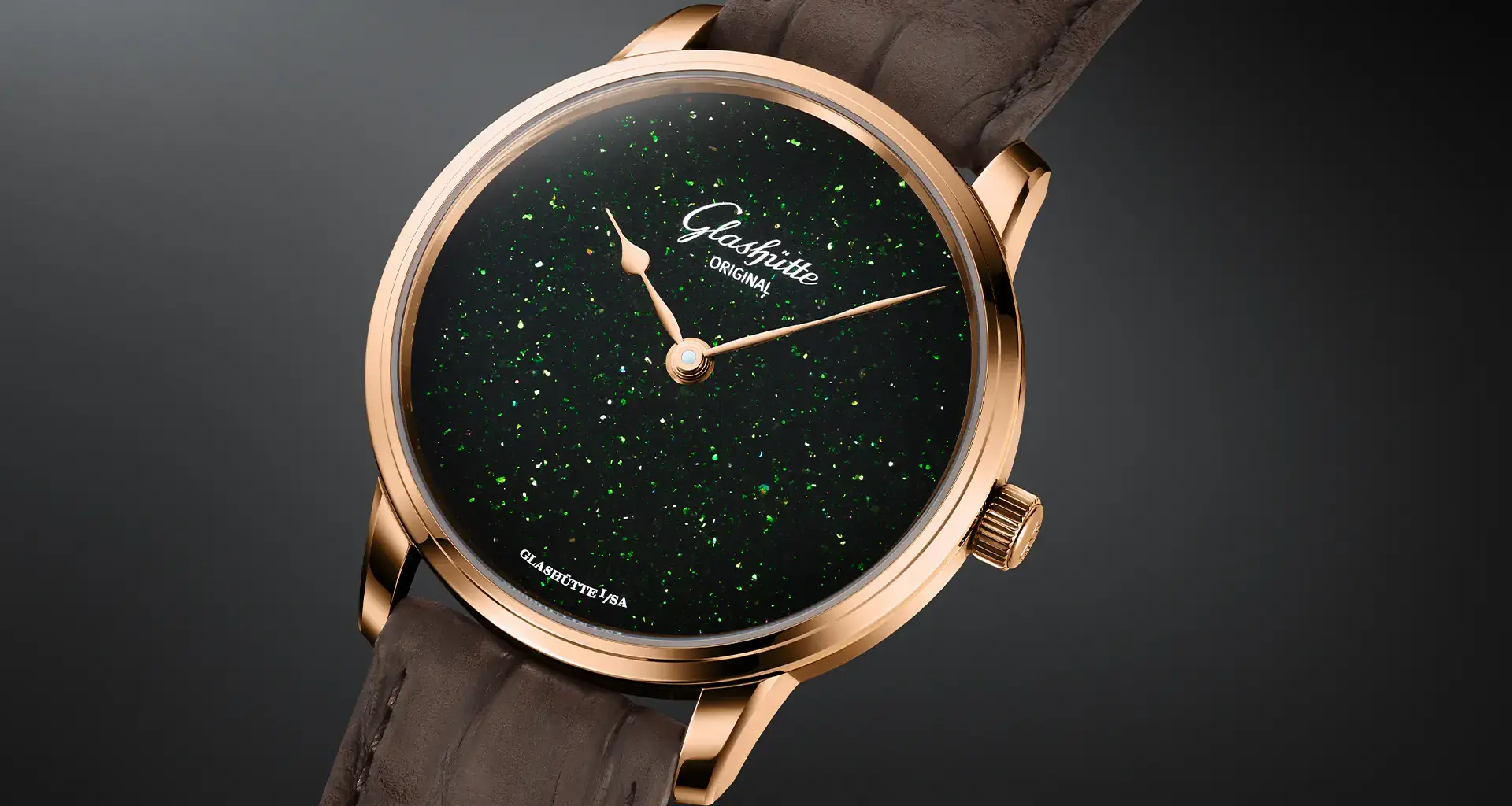
Aventurine rewards movement. Tiny reflective particles change their relationship with the light as the wrist turns, giving a flat disc an impression of depth. Glashütte Original leaves that effect unusually exposed. Hours and minutes occupy the face without a calendar aperture or a conventional seconds display competing for attention. The omission is an active design decision: every additional indication would divide a surface whose attraction depends on continuity. For a manufacture associated with conspicuous date displays and complicated layouts, choosing fewer indications is a meaningful form of confidence.
Glass, rather than a gemstone claim
The dials use aventurine glass. This should not be confused with the naturally occurring quartz material that shares the name. The maker describes metal oxides added to molten glass to create the shimmering inclusions. Green with red gold gives Art Nouveau Green a warm, organic reading; blue with platinum makes Art Déco Blue cooler and more architectural. These artistic references provide a lens through which to see the watches, not evidence that either is a literal reproduction of an early twentieth-century object.
Restraint outside, substance behind
The calibre 36-16 brings a 100-hour reserve and a silicon balance spring to the proposition. The long reserve has a practical value for someone rotating several watches: fewer interruptions between wears. The sapphire back supplies the mechanical interest deliberately withheld from the dial. Atelier construction also places emphasis on how the watch is assembled and regulated. With no fixed edition ceiling stated, the purchase argument is not a numbered shortage; it is the relationship between an unusually quiet face and a carefully executed mechanism.