
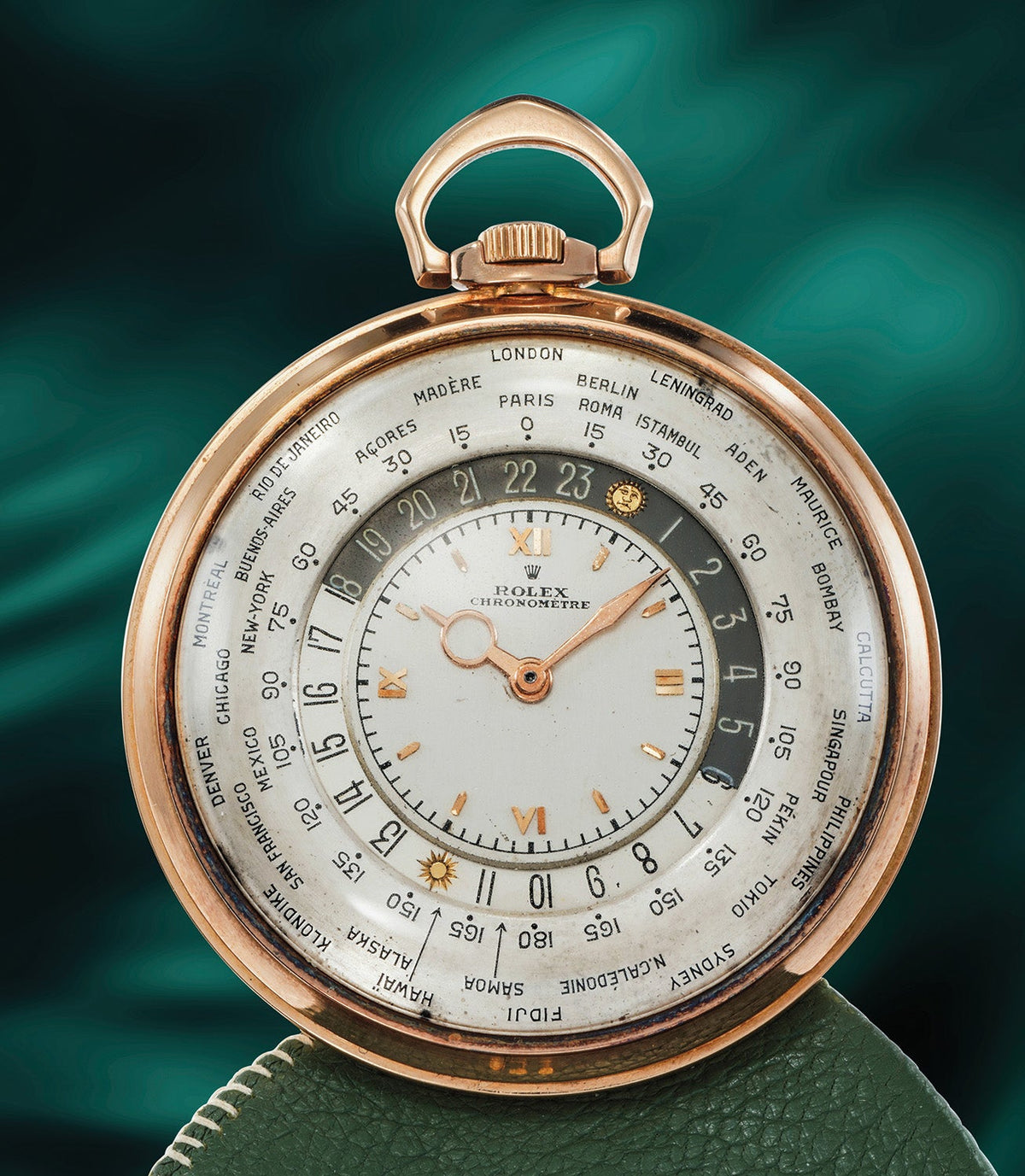
FROM THE ARCHIVE · ROLEX REFERENCE 4262
A dial to match a photograph. Delivery by the end of February. A letter dated 7 January 1948 brings an extraordinary Rolex into focus—and reveals the people behind the name on its dial.
Cover photograph: Phillips — Rolex Ref. 4262.
The letter begins with the business of making a watch. Writing from Geneva, Rolex’s manufacturing department confirms a telephone conversation with dial maker Stern Frères: the dials must follow the photograph already in the firm’s possession, and they are needed by the end of February. For the recipient, these were instructions to fulfil. For a reader today, they offer a way into a little-known chapter of Rolex history.
A third name appears in the correspondence: Cottier. Follow it, and the watch takes on a different character. Behind the Rolex signature stood a specialist watchmaker and a dial manufacturer, working on a pocket watch that could show the time across the world.

A World Arranged Around Two Hands
The watch is the reference 4262. Its display is easier to understand than its crowded dial first suggests. Two central hands give the local time. Around them, a 24-hour ring works against a circle of city names, allowing the wearer to read the corresponding time elsewhere. Light and dark sections distinguish day from night.
The system was the work of Louis Cottier. According to Phillips, he retained his patent and personally adapted movements for the firms that used his invention. His name in the letter therefore matters: the correspondence identifies the dials as having been ordered by the Cottier firm. It gives the watchmaker a place in the production record, beyond the finished object.


The Stern Connection
The addressee brings another familiar name into the story. Charles and Jean Stern, whose dial-making business supplied Patek Philippe, acquired that watchmaker in 1932, as Patek’s official history records. Here, their firm appears in a Rolex manufacturing letter. The document offers a small but revealing glimpse of the relationships through which Swiss watches were made.
It also rewards careful reading. The 38mm measurement in the letter refers to the opening of the case bezel, rather than the watch’s overall diameter. The example catalogued by Phillips measures 44.5mm across. Confusing the two would turn a workshop specification into an incorrect description of the finished watch.
Inside the Case
A close view of the movement changes the scale of the story. The eye moves from cities and time zones to wheels, screws, jewels and the Rolex name engraved on a bridge. This is the machinery beneath the display: the physical watch behind the photograph and the production instructions.

One Letter on the Dial
There is another detail worth pausing over. Phillips notes a change in the spelling of Istanbul between the two batches, with an M replaced by an N. It is a useful distinction when comparing surviving examples. The visible letter, however, asks for dials matching a photograph; it does not explicitly instruct Stern Frères to correct the city’s name. The document and the later catalogue account offer related evidence, but they do not establish the same thing.

Twelve Watches, One Surviving Letter
Phillips describes a believed production of just twelve examples: six in 1943 and six in 1947–1948. That is an estimate of how many were made, rather than a confirmed count of how many survive. Even with that qualification, it places the reference 4262 in a very small corner of Rolex production.
Return to the letter and its deadline. A manufacturer needed dials; a supplier had a photograph; a specialist’s name sat in the correspondence. Each had a task in getting the watch made. Nearly eight decades later, those ordinary instructions let us see the collaboration more clearly: Cottier’s system, Stern’s dial work, and Rolex’s name on a watch that brought distant cities within a glance.
More photographs: dial, movement and case


Sources: Phillips — reference 4262 and its two production batches; Rolex Magazine — the letter and research by José Pereztroika; Patek Philippe — the Stern family’s history.
Photography: Phillips and Rolex Magazine; rights remain with the respective rights holders. The photographs show more than one example of reference 4262. Rolex Magazine is an independent specialist publication.


