
As of 3 November 2026, Omega's official Hong Kong pages for the Speedmaster X-33 Skywalker and Marstimer say the watch is no longer available. That is evidence about one storefront. It is not an announcement that the X-33 has ended.
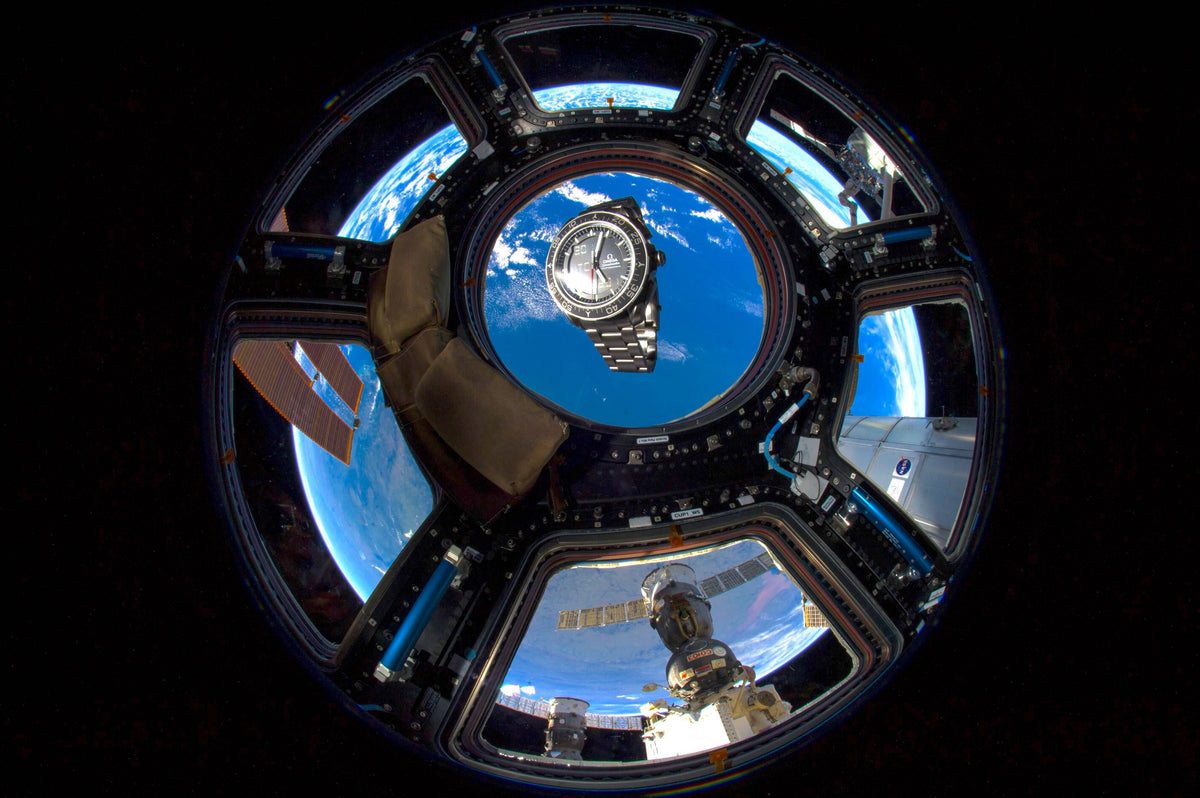
Cover image: a Skywalker X-33 floating in the ISS Cupola during Alexander Gerst's 2014 mission. Photograph: © ESA/NASA – A. Gerst. Published 3 November 2026; reviewed 4 November 2026.
Confirmed
Omega's Hong Kong pages for the Skywalker (reference 318.90.45.79.01.001) and the Marstimer (reference 318.90.45.79.01.003) state that the watch is no longer available, as of 3 November 2026.
Not confirmed
A worldwide end of production. The reason for the decision. A successor or a launch date. The future of servicing for existing watches. Any professional supply arrangement.
These are separate questions. A retail withdrawal does not settle them.
A different kind of Speedmaster
The X-33 is not a mechanical Moonwatch. It is an analogue-digital mission timer: it coordinates events, tracks intervals and sounds an alarm when attention is required. Introduced in 1998, it extended the Speedmaster into electronic timing, combining hands with a digital display and programmable functions.
The 2014 Skywalker made that purpose clear. It incorporated an ESA patent based on ideas from astronaut Jean-François Clervoy, helping users track mission events and calculate elapsed or remaining time.

The X-33 timeline
- 1998: the X-33 arrives, with hands, a digital display and programmable functions.
- 2014: the Skywalker, incorporating an ESA patent.
- September 2022: the Marstimer, with Mars-specific functions.
- 3 November 2026: Omega's Hong Kong pages list the Skywalker and Marstimer as no longer available.
Marstimer: a watch for a longer day
Launched in September 2022, the Marstimer carries Mars-specific functions conceived by ESA engineers and scientists to support operations for the Rosalind Franklin rover. The requirement came from teams working on Earth. The name does not mean the watch has been to Mars.
Its 45mm Grade 2 titanium case houses Omega's thermocompensated quartz calibre 5622. The watch tracks the date and time at Mars's prime meridian alongside terrestrial time. A Martian solar day runs about 39 minutes longer than an Earth day, a real scheduling challenge for teams working across both cycles.

Why a specialised instrument is hard to sustain
A tool built around mission schedules serves a narrow need, while a luxury customer may prefer a watch that feels immediately familiar. Range consolidation is a plausible commercial reading of the withdrawal, but it is only a reading. Omega has given no verified explanation, and available model-level figures do not justify calling the X-33 a commercial failure or blaming production costs.
What "space-qualified" does and does not mean
ESA tested the Skywalker for vibration, acceleration, vacuum, temperature and radiation, and evaluated the Marstimer at its ESTEC technical centre. These are substantial credentials, but a qualification has a defined scope. Calling a watch space-qualified does not automatically approve it for every task, including extravehicular activity.

Thinking of buying one? Check these five things
Discontinuation alone does not guarantee that a watch will appreciate. Before rarity becomes the reason to buy:
- Reference: match 318.90.45.79.01.001 for the Skywalker or 318.90.45.79.01.003 for the Marstimer.
- Display: confirm the digital display is intact.
- Controls: test the alarms, timers and every button.
- Electronics: ask about the condition, the battery and the date of the last change.
- Servicing: confirm a service centre will accept the watch before you pay.
What should the next X-33 do?
A future X-33 should be judged on legibility, simple programming, effective alarms and long-term serviceability. New display technology or phone connectivity may be conceivable, but neither should be presented as an announced feature.
Our view: the X-33's lasting contribution is that it let a professional requirement shape a luxury watch. Until Omega announces a new product, the difference between a retail withdrawal and the end of an idea is the heart of the story.
We will update this article if Omega publishes a statement or the status of the pages changes.
Sources: Omega Hong Kong, official product pages for the Speedmaster X-33 Skywalker (318.90.45.79.01.001) and X-33 Marstimer (318.90.45.79.01.003), reviewed 3 November 2026; European Space Agency material on the Skywalker patent and Marstimer testing; Omega press images, © OMEGA; ESA/NASA image, © ESA/NASA – A. Gerst.
Read next: Omega’s Gulf Ambition Meets a More Demanding Watch Market