
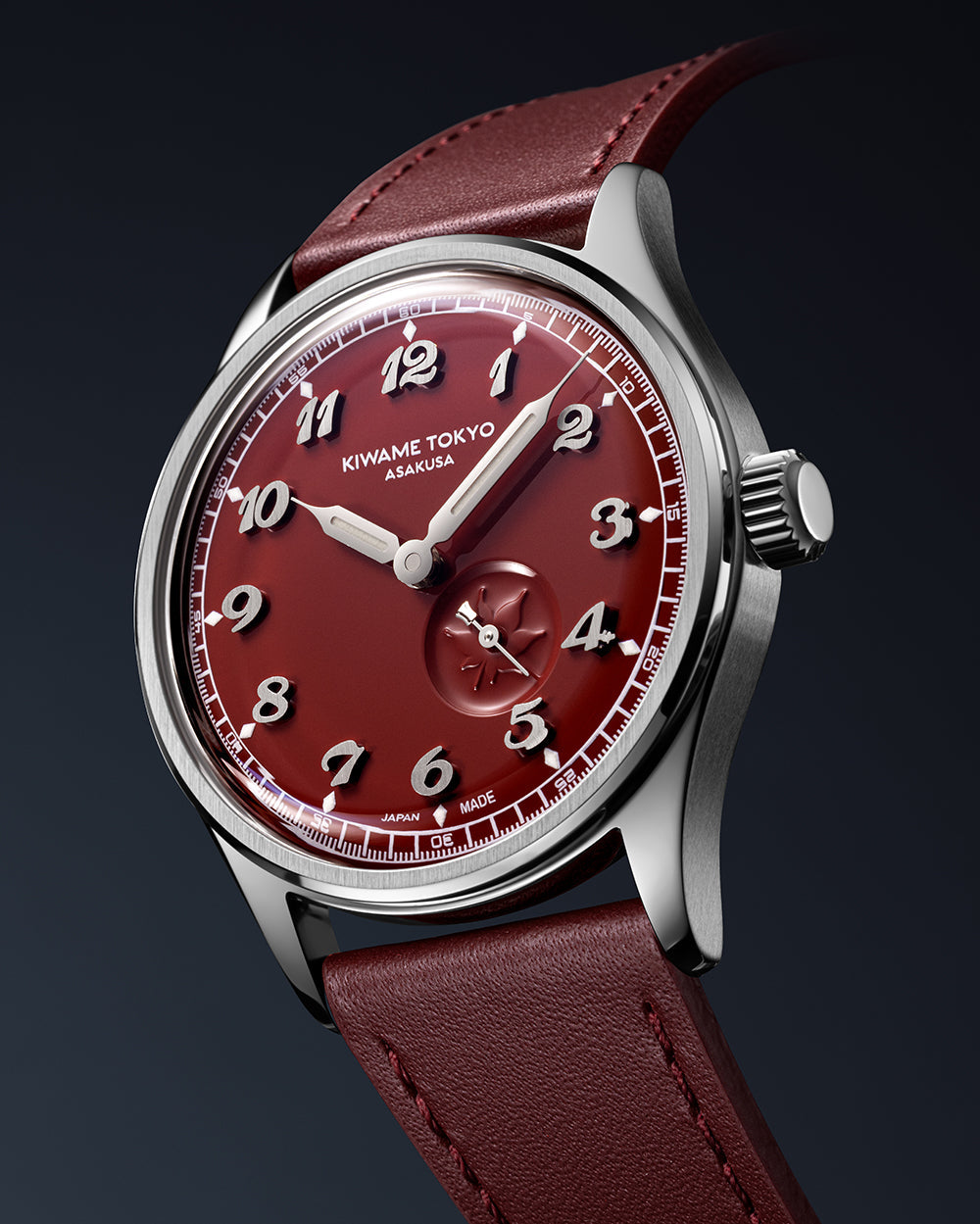
An autumn-red dial and a restrained maple leaf put a familiar mechanical platform to a more interesting test: can the design make the watch its own?
The case for buying a design
A new movement is one way to make a watch interesting. Making familiar components feel particular is another, and the latter can be a revealing test of a small brand. Kiwame Tokyo’s Kubo Momiji approaches it through an autumn-red dial and a maple leaf that occupies surprisingly little space. Its appeal rests on the relationship between colour, relief and proportion, rather than on mechanical exclusivity. That changes the buying question. Once the movement is understood as a component available to other makers, how much value does the completed design create around it? Momiji deserves to be considered on that basis, without asking a seasonal colour to stand in for technical invention.

Experience before the brand
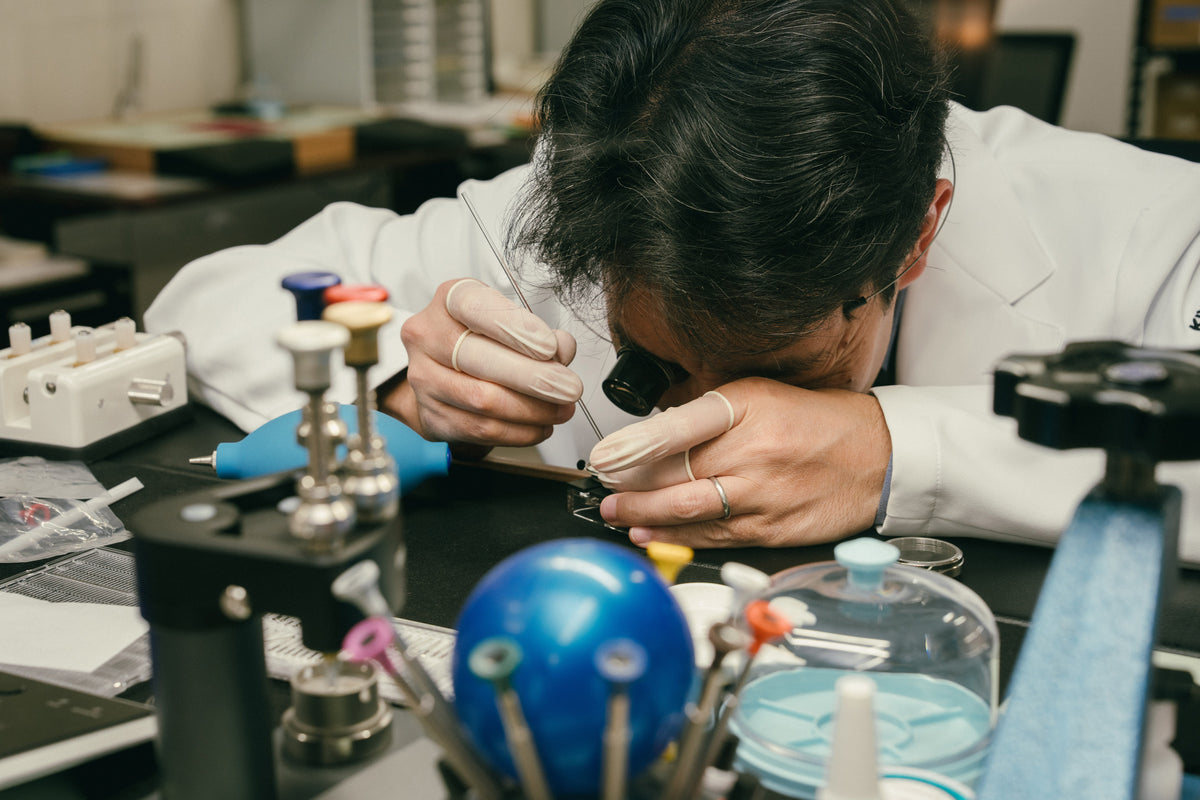
Masami Watanabe came to his own watch project after more than three decades introducing overseas timepieces to Japan. The company locates its identity in Asakusa, Tokyo, and presents craftsmanship and attention to detail as central to its purpose. That background matters commercially. Someone who has communicated other brands’ appeal will know that a competent specification sheet cannot, by itself, make a new name memorable. A recognisable visual vocabulary can do more. Seasonal references offer a way to develop that vocabulary across a collection, provided the story remains accountable to the object. Place and experience establish a context; the quality of the finished watch and its subsequent support must sustain it.

The leaf is only part of the composition
The red takes its cue from Koimomiji, a traditional colour associated with deepening autumn foliage. More revealing is the small-seconds recess between four and five o’clock. A maple leaf rises within that hollow, sharing its colour, while the applied numerals stand above the main dial. The eye moves through levels rather than across a decorative print. Leaving the seconds display without a dedicated scale makes the compromise explicit: this is a running indication with an architectural role, not an especially useful instrument for timing short intervals. The leaf’s restraint helps the idea. It invites discovery through changing light instead of turning the entire dial into an illustration.

An ordinary calibre shifts the burden of proof
The automatic Miyota 82S5 supplies approximately 42 hours of running time at 21,600 vibrations per hour. Kiwame describes its movement as regulated, but gives no tighter, watch-specific accuracy commitment on the product page. Regulation should therefore remain a process description, not become an implied chronometer claim. A widely available calibre can be a sensible choice; it simply asks proportion, finishing and assembly to carry more of the product’s distinction. Published dimensions of 37mm across and 45mm from lug to lug establish a compact outline. Water resistance of 30 metres, together with a leather strap, also places practical limits around the field-watch suggestion of its brushed bezel. This is a proposition for ordinary urban wear, rather than a purchase to justify through aquatic capability.
A price is a fact; scarcity needs evidence
The announced international price is USD 630 before tax; the official product page displays JPY 84,700. The purchase is a complete design built around accessible mechanics, and that is a legitimate proposition to evaluate on its own terms. The English-language page schedules pre-orders for 17 November 2026 at 9am Japan time, with delivery expected in early January 2027 and one watch per person across Kubo. Its present sold-out label does not establish the success of that future order window, nor does the page supply a numbered production limit. The useful questions begin after checkout: whether delivery matches the promise, whether execution remains consistent, and how the owner is supported. A distinctive colour earns attention; those less photogenic disciplines turn attention into a watch business.
Specifications and price
| Reference | KT304 |
|---|---|
| Case | 316L stainless steel |
| Diameter × lug-to-lug | 37 × 45 mm |
| Thickness | 9.3 mm; 10.7 mm including crystal |
| Crystal | Domed sapphire; inner anti-reflective coating |
| Movement | Miyota 82S5; automatic / hand winding; hacking |
| Reserve / frequency | Approx. 42 hours; 21,600 vph; 21 jewels |
| Functions | Hours, minutes, small seconds |
| Water resistance | 3 ATM / 30 m |
| Strap | Italian calf leather; quick release; 20–16 mm |
| Announced price | JPY 84,700 / announced USD 630 |
| Orders / expected delivery | 17 November 2026, 09:00 JST / early January 2027 |


